Not chat history
1DB is not a transcript archive or session store. It preserves what communication means across actors, projects, permissions, and time.
Semantic persistence
1DB turns communication events into durable cognition so agents, people, projects, files, workflows, and systems can act with situated memory instead of isolated recall.
Node Vertex lets everything communicate. 1DB lets the fabric remember what communication means.
Explore API Read Architecture Join Waitlist
Live private preview
Core narrative
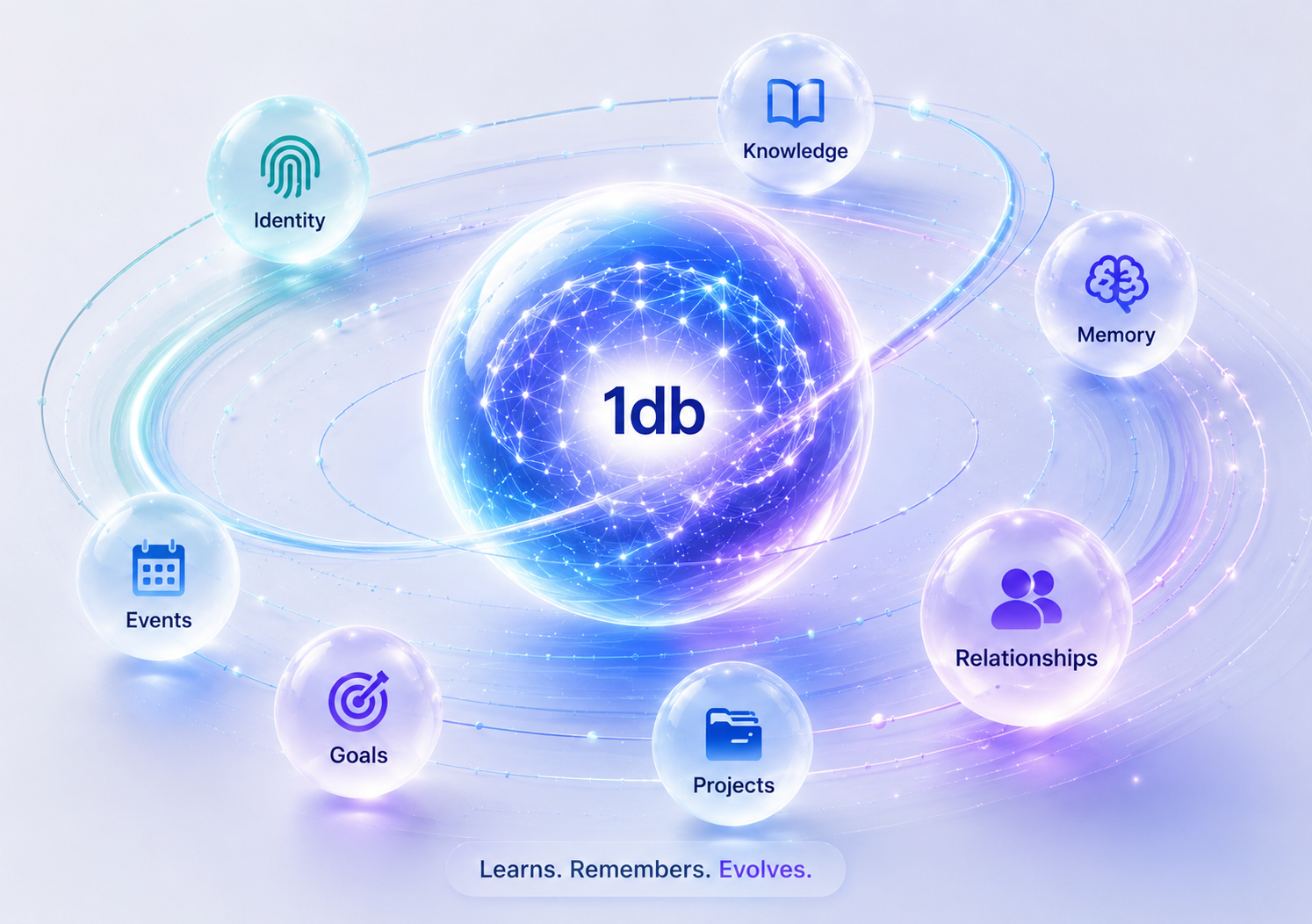
Communication is the primitive. Memory is the residue of communication. 1DB converts that residue into durable cognition: identity, relationships, trust, context, temporal causality, governance, and simulation.
1DB is not a transcript archive or session store. It preserves what communication means across actors, projects, permissions, and time.
Similarity search can find nearby text. It cannot decide scope, provenance, contradiction, identity drift, or current trust by itself.
Memory becomes an evolving substrate that can strengthen, decay, contradict, correct, and participate in future action.
Eliminate session amnesia
AI systems often begin each new conversation with incomplete operational context. Users repeat how a project is structured, which tools are required, what actions are prohibited, how deployments work, and which team conventions matter.
Repeated setup slows every new session and wastes expert attention.
Critical standards and preferences drift when context is reconstructed by memory or copied from old prompts.
As projects grow, forgotten deployment, security, and workflow constraints become execution hazards.
Project Cognition
Project Cognition is persistent, versioned execution continuity for how an AI should operate within a project, team, workspace, tenant, repository, environment, or domain.
Architecture, workflows, constraints, standards, preferences, security requirements, and operating procedures become durable context instead of repeated instructions.
const cognition =
  await cognition.loadProject("project-alpha");
The AI starts with the correct project-aware intelligence.
Cognitive layers
1DB stores continuity at the layers where intelligent systems actually operate: people, teams, projects, personas, organizations, workflows, and communication endpoints.
What an AI knows about an individual.
What an AI knows about a group or organization.
How an AI should operate within a specific project or workspace.
What makes a particular AI persona unique.
Policies, standards, governance, and institutional knowledge.
What is 1DB?
1DB observes communication events, converts meaningful activity into durable cognitive state, and compiles relevant context for authorized agents and systems. It is cognitive infrastructure for the Agent Internet.
Observe communication events, tool calls, workflow transitions, file changes, decisions, and outcomes with provenance.
Convert meaningful communication into scoped memory, identity signals, relationship paths, trust evidence, and temporal state.
Compile task-ready context packets for agents based on actor, goal, permissions, channel, and current contradictions.
Preserve continuity across people, agents, projects, workflows, files, systems, and organizations.
Cognition graph
A cognition graph begins with facts, then connects them through relationships whose strength changes the result. The same inputs can produce different outcomes when the association weight shifts.
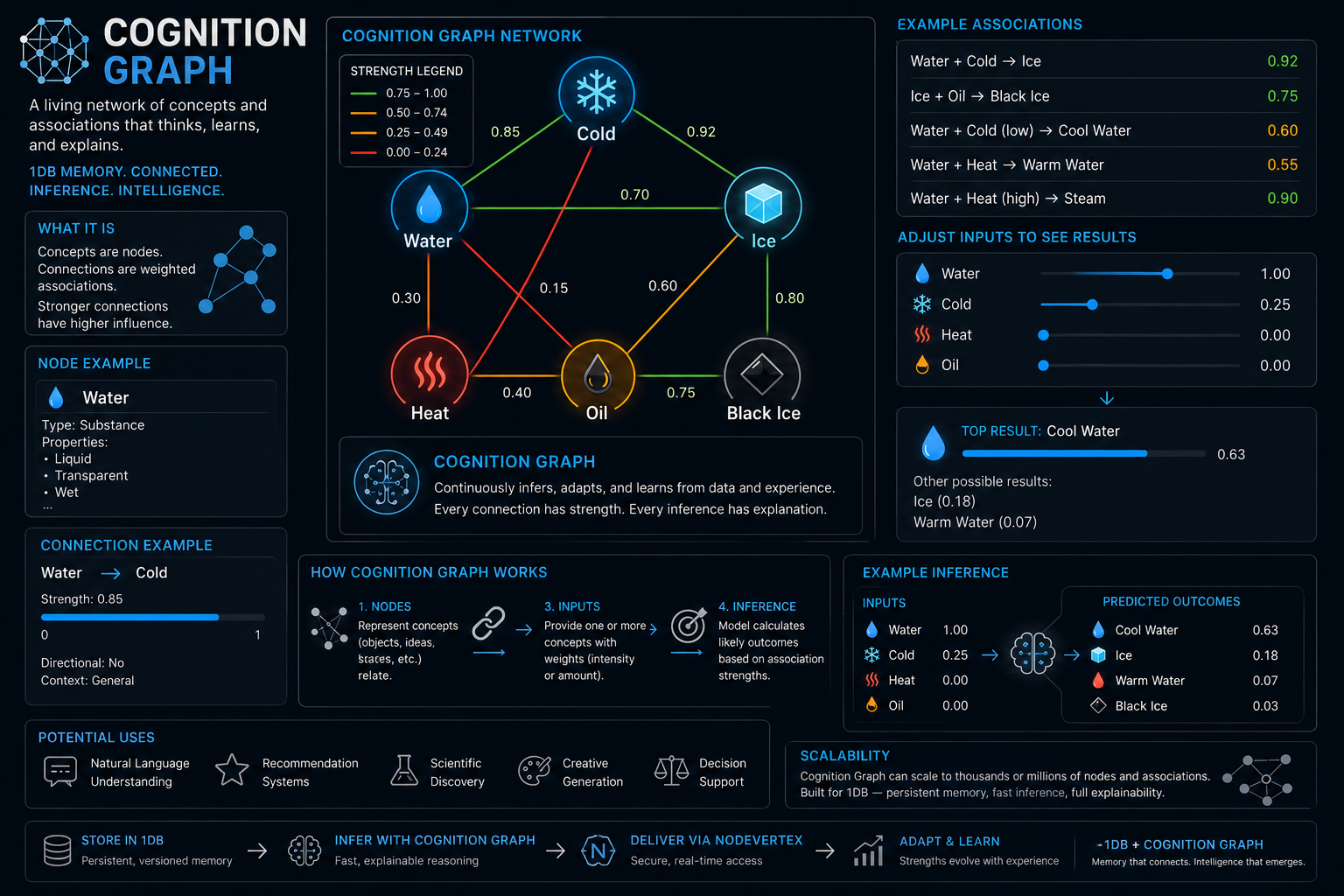
Water exists.
water + cold -> icewater 1.0 + cold 0.25 -> cool waterwater 1.0 + cold 0.90 -> iceice + oil + road -> black iceWhy 1DB?
Ordinary memory stores claims. Vector search finds similarity. Chat history preserves transcripts. RAG retrieves documents. 1DB preserves scoped, provenance-aware cognition that can evolve across time, identity, trust, relationships, and permissions.
{ layer: "temporal", entity: "acme", event: "security review changed priority", caused_by: "new residency requirement", confidence: 0.84, scope: "project" }Temporal cognition
1DB treats time as semantic change: what happened, when it happened, why it mattered, what changed, what it influenced, and how meaning evolved.
Events are understood in sequence, not as disconnected records.
Facts can point to causes, effects, contradictions, reinforcements, and downstream consequences.
Context changes over time through decay curves, reinforcement, importance, and recency.
Evolving significance
It is evolving significance.
1DB treats decay and reinforcement as cognitive infrastructure primitives: confidence scoring, contradiction resolution, semantic strengthening, contextual prioritization, importance weighting, memory merging, and memory aging.
await db.memory.remember(fact)
await db.identity.reinforce(signal)
await db.memory.decay({ curve: "contextual" })
await db.relationship.merge(conflict)
await db.timeline.query({ relevance: "now" })
Persona continuity primitive
Measure how consistently an intelligent system preserves tone, memory, identity, goals, relationships, preferences, and behavioral traits across sessions, devices, channels, and years.
Continuity is tracked as infrastructure, not as a branded personal assistant experience.
Systems can observe where tone, preferences, goals, or memory diverge from prior state.
Agents can remain consistent across APIs, apps, devices, workflows, and organizations.
Simulation and future reasoning
Potential capability: 1DB can model hypothetical branches, projected outcomes, future-state reasoning, comparative simulations, retained reasoning paths, and temporal scenario analysis as the simulation layer matures.
await db.simulation.project({
  entity: "supply-chain",
  horizon: "90d",
  branches: ["delay", "price shock", "new supplier"],
  retain_reasoning: true
})
Enterprise cognition
Institutional continuity disappears through turnover, disconnected systems, siloed applications, and fragmented AI tooling. 1DB creates shared organizational cognition across humans, agents, applications, infrastructure, workflows, and distributed systems.
Teams and agents share durable context instead of re-learning the same facts.
New knowledge updates the graph and becomes available to authorized systems in realtime.
Multiple agents coordinate around shared facts, goals, context, and temporal state.
Architecture
Addressability, transport, routing, live coordination, governance surfaces, and programmable communication endpoints.
Observed communication, actions, state changes, outcomes, tool calls, workflow events, and provenance envelopes.
Entities, memories, relationships, concepts, identity signals, trust signals, and evidence links.
Sequence, causality, decay, reinforcement, contradiction, correction, and evolution.
Task-ready fabric state scoped by actor, goal, channel, tenant, and permission.
Action, reasoning, simulation, and communication through live endpoints.
CFT primitives
Messages, actions, tool calls, file changes, decisions, state transitions, and outcomes captured as first-class events.
Durable, scoped, provenance-aware representations of meaningful communication or observed state.
Continuity patterns that persist across communication, behavior, time, and relationships.
Weighted paths of relevance, trust, permission, dependency, and meaning between entities.
Compiled local state for this actor, this situation, this goal, and these permissions.
Confidence based on provenance, repetition, contradiction, source quality, relationship, and freshness.
Sequence, causality, decay, reinforcement, contradiction, correction, and evolution.
Projected communication or action futures based on current memory, identity, relationships, goals, and constraints.
Tenant boundaries, consent, recall scope, retention, permissions, and auditability as cognitive primitives.
Before and after
| Old framing | CFT-native framing |
|---|---|
| AI memory database | Semantic persistence layer for the communication fabric |
| Give AI memory | Give the fabric continuity |
| Store and retrieve memories | Observe communication, persist cognition, compile context |
| AI + Memory = Persona | Communication + Memory + Time + Identity = Persistent Agency |
| Vector memory | Memory, identity, relationships, trust, context, time, and governance |
| Persona profile | Identity continuity pattern across behavior, communication, relationships, and drift |
Trust and governance
Durable memory should trace back to observed communication, state, actor, source, time, and evidence.
Context compilation must respect tenant boundaries, permissions, task purpose, consent, and channel constraints.
Identity is a continuity pattern, not a static profile. Divergence and reinforcement both matter.
Compiled context should account for unresolved contradictions, deprecated memories, and low-confidence claims.
Some memories lose relevance. Decay and reinforcement are core cognitive operations.
Databases were built for applications. 1DB is built for persistent agency.
Cognitive API direction
db.observe(event)
db.memory.remember(observation)
db.identity.reinforce(actor, signal)
db.relationship.link(a, b, meaning)
db.context.compile(situation)
db.trust.evaluate(claim)
db.temporal.reconstruct(entity)
db.simulation.project(goal)
Private preview
Join the 1DB waitlist for early access to semantic persistence, scoped context, relationship-aware cognition, temporal awareness, and agent continuity.